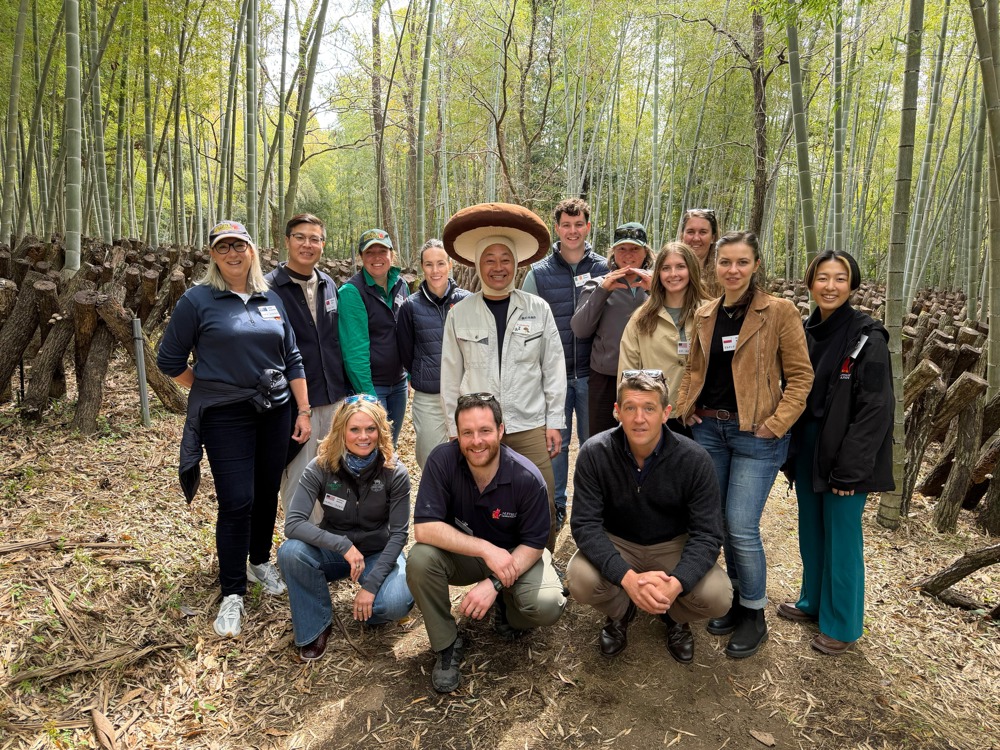
What happens when you send eleven farmers to six countries and ask them to pay attention?
They went to Japan, Vietnam, Kenya, the Netherlands, Spain and Texas. They came back with a clearer view of where farming is heading — and why the questions matter more than the answers.
There's a moment every Nuffield Scholar talks about. It's not when they land somewhere exotic or shake hands with a world-class producer. It's the moment when something they thought was a uniquely Australian problem turns up in a Kenyan flower farm, a Dutch dairy, or a Vietnamese rice paddy. That's when the penny drops.
Global Focus Program 1 put eleven scholars on the road for five weeks across Japan, Vietnam, Kenya, the Netherlands, Spain and Texas. They came from Australia, New Zealand, Ireland, Canada, Poland, Taiwan, the UK and the US. They sat with farmers, processors, researchers and policymakers. They asked a lot of questions.
What they found wasn't surprising in the big picture — the same challenges keep appearing everywhere. Water. An ageing workforce. The gap between what a farm produces and what a producer gets paid for it. But the details were sharp and specific. And the details are where the useful thinking lives.
Japan: the country that's figured out something we haven't
Japan has a farming problem. The average age of a Japanese farmer is over 67. In the Kyushu region, the group saw operations where foreign workers already make up a significant share of the labour force — and that number is only going up. On paper, Japanese agriculture looks like it's slowly running out of road.
But then you visit Yamae Foods. They produce around 1,000 varieties of soy sauce and launch up to 100 new products a year. Not because they have the fanciest factory, but because they've built extraordinary depth into product development, storytelling and customer connection. The same approach drives premium pricing on milk, shiitake mushrooms and other staples across the region.
Or you look at Aoi Farm, which coordinates hundreds of small growers under a single contract system — giving them scale they couldn't achieve alone, and pricing power they'd otherwise never see.
The lesson from Japan isn't about robots or agtech. It's that the most durable competitive advantage might be the one you build in a story, a relationship, or a product range — not on the factory floor.
Vietnam: the fastest-moving farming country they visited
The Mekong Delta grows around 90% of Vietnam's rice. It's also one of the most climate-exposed agricultural regions in the world. Saltwater intrusion is creeping further inland each year. Soil pH is declining. Water flows are being shaped by decisions made upstream, well outside Vietnam's control.
None of that seems to have slowed anyone down. What struck the group most in Vietnam wasn't the pressure — it was the pace of response. Farmers are trialling drones, rice-shrimp rotation systems, regenerative practices and QR-code traceability without waiting for a government programme to catch up. Vietnam has a national net-zero 2050 target, and on-farm emissions reduction in rice systems is actively underway.
The honest caveat: the gap between government ambition and on-farm reality is wide. Farmers sit at the centre of the food system but often at the bottom of the value chain. For Australian producers watching Asian markets closely, Vietnam is one of the most important stories to follow.
Kenya: what 'world class' looks like when it's sitting next to everyday
Kenya produced some of the starkest contrasts of the trip. The country's horticultural and flower export sector is genuinely world-class. Processing standards, cold chain management, social employment practices — some of the large-scale operations the group visited would hold up against the best anywhere.
At the same time, they saw everyday farming realities that were impossible to ignore: operations where people are farming not because they chose it but because there weren't other options. Where corruption, seed access restrictions and regulatory friction are daily headwinds.
"Nuffield programs often expose you to the best of a system. Kenya was a reminder that seeing the full picture — not just the standout operations — is where the real thinking happens."
The Netherlands: technically brilliant, socially complicated
If you want to see what high-productivity agriculture looks like, the Netherlands is hard to beat. With some of the world's most productive farmland per hectare and a sophisticated processing and logistics sector, Dutch farmers have built something remarkable in a small country surrounded by a lot of people.
That proximity is also the pressure. Nitrogen rules introduced in recent years have effectively frozen growth for many operations. Land prices keep rising while farm-gate returns stay relatively flat. Public scrutiny shapes day-to-day decisions — the group heard stories of farmers managing whether their cows were visible from the road, because a photo can become a media story within hours.
Some Dutch farmers feel the policy environment is actively pushing them out. The lesson isn't that the Netherlands is doing it wrong — it's that technical excellence alone doesn't secure a farming future. Social licence, economics and regulation have to travel together.
Spain: producing 60% of the world's olive oil and seeing less of the value than you'd think
Spain is the seventh largest food exporter in the world. It grows around 60% of global olive oil production. Yet a substantial portion of that oil leaves Spain in bulk and comes back on supermarket shelves under Italian brands. The product is Spanish. The story, and the margin, belongs to someone else.
Water is the single biggest constraint in Spanish agriculture — more than land, more than labour. Land values in some regions have tripled in the last decade, but it's water allocation, not land price, that limits what's actually possible.
The cooperative structure is one of Spain's genuine strengths — around 4,000 cooperatives represent close to 90% of producers. And businesses like Castillo de Canena show what happens when a producer stops selling a commodity and starts selling a provenance — exporting premium, traceable product to more than 50 countries.
Growing good product and capturing the value from it are two very different skills. Spain has the first in abundance. The second is the work still being done.
Texas: the biggest beef state in the US, and a water problem that's coming
Texas produces more beef than any other US state. The scale is genuinely impressive, the risk management tools are sophisticated, and the investment in beef promotion and marketing is serious.
Underneath all of that, there's the Ogallala Aquifer. In some areas, irrigation capacity has dropped by up to 90% over the past twenty years. There is no coordinated plan to recover it. Population growth, solar farms and data centre development are pushing land values up and agricultural water access down.
The group came away thinking hard about what an individualistic approach to shared resources looks like over time. The generation farming there now may be the one that faces the reckoning.