Can Tree-crop Horticulture Survive the Next ‘Big Blow’?
“The next ‘big blow’ is not a matter of if, it’s a matter of when. If tree-crop horticulture in Northern Australia is to survive the decades ahead, resilience must become the foundation of orchard design.”
A Far North Queensland tropical fruit grower is urging Australia’s tree-crop industries to rethink how orchards are designed and managed, warning that increasing Tropical Cyclone intensity poses a serious threat to the future of horticulture in Northern Australia.
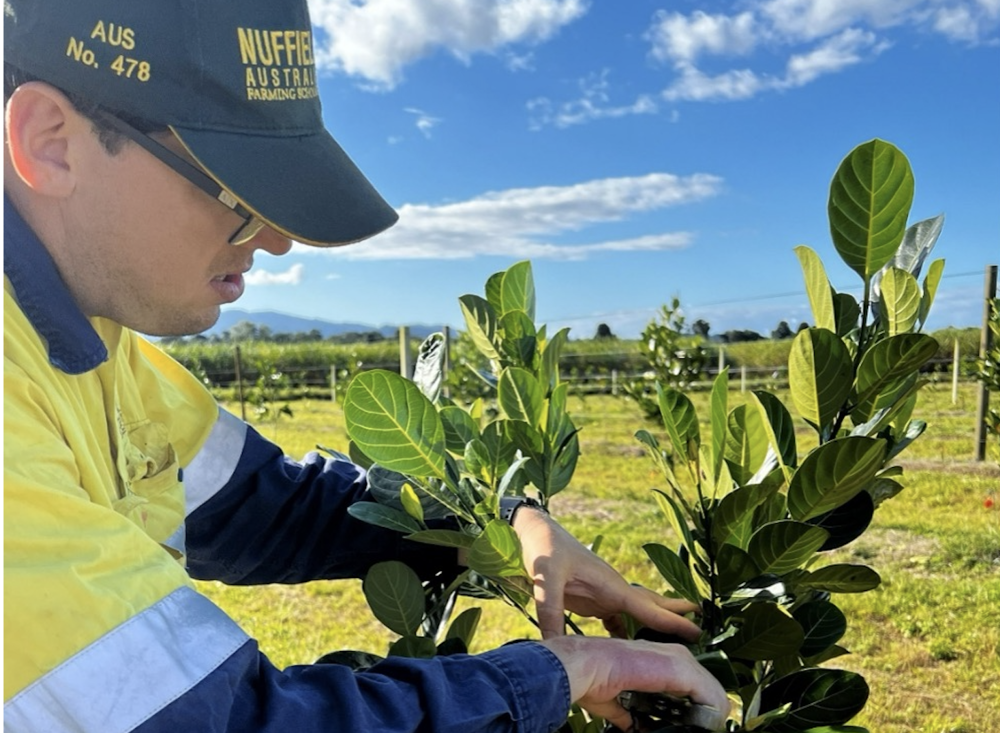
Joshua Maunder, 2021 Nuffield Australia Scholar from Bellenden Ker, Queensland, has released his report Can Tree-crop Horticulture survive the next ‘big blow’?, examining the current and future risks Tropical Cyclones present to Australian agriculture and identifying practical management and mitigation strategies for growers.
Supported by Westpac Agribusiness, Joshua’s research highlights that while the total number of Tropical Cyclones may decrease, climate modelling suggests their severity is likely to increase, intensifying risks to orchards, infrastructure and long-term food security.
“Tree-crops are one of the most vulnerable commodities a grower can produce in Northern Australia,” Joshua said.
“With large upfront capital investment, long establishment periods and tight margins, a single event can wipe out orchards, destroy export markets and financially cripple growers.”
Australia experiences an average of 11 Tropical Cyclones each year, with five crossing the coast. Economic impacts to agriculture are projected to cost between AUD $300 million and AUD $1.2 billion annually, with cumulative costs estimated at approximately AUD $23 billion since 1967.
Joshua’s report found a notable lack of preparedness within the sector and argues that resilience must move beyond a business mindset and become embedded in orchard design, planting material and production systems.
Key management strategies identified include high-density plantings, trellising and supported structures, improved canopy management, stronger varietal genetics and propagation practices, and the potential use of greenhouse and hothouse technologies to decouple production from peak cyclone timeframes.
“The most effective long-term solution is likely to involve engineered greenhouse and hothouse production systems,” Joshua said.
“If growers are to manage evolving cyclone risks while maintaining productivity and profitability, alternative production mechanisms must be seriously considered.”
The report also highlights the need for coordinated action across growers, nurseries and government, including investment in research, development and extension, improved propagation practices and exploration of industry insurance mechanisms.
Joshua presented his findings at the 2025 Nuffield National Conference in Adelaide, South Australia.
His full report is now available HERE.